Utah County is not a single climate – it is a collection of microclimates stacked between 4,500 and 8,000 feet in elevation, each with its own thermal patterns, precipitation profiles, UV intensity, and wind dynamics. The Wasatch Front valley floor in Lehi behaves differently than the east bench communities of Springville, which behave differently still from the mountain communities approaching the Wasatch canyons.
Luxury custom home design that ignores these realities – that treats Utah County as if it were Phoenix or Denver – ends up with beautiful homes that age poorly, perform inefficiently, and demand costly maintenance. The builders and architects who have worked here long enough understand that every design decision, from roofline pitch to exterior cladding to window specification, should respond to where the home actually sits.
The Key Climate Characteristics Every Utah County Builder Must Address
Extreme UV Exposure
At Utah County’s elevations, ultraviolet radiation intensity is significantly higher than at sea level – comparable in some measurements to coastal Florida despite the inland location. This matters enormously for exterior materials. Wood siding, composite decking, exterior paint, roofing membranes, and even window seals degrade measurably faster under high UV exposure.
Premium custom builds in the area specify UV-resistant exterior finishes, high-performance coating systems, and roofing materials rated for high-altitude UV exposure. These are not luxury additions – they are baseline requirements for durability in Utah County’s light environment.
Significant Temperature Differential
Utah County regularly experiences temperature swings of 30 to 40 degrees Fahrenheit in a single day, particularly in shoulder seasons. This thermal cycling stresses building materials at every joint, fastener, and connection point in the building envelope.
The freeze-thaw cycle – water entering micro-gaps in masonry, flashing, or improperly sealed penetrations, freezing, expanding, and forcing those gaps larger – is one of the primary causes of premature envelope failure in Utah County homes. Well-designed luxury builds account for this with continuous insulation strategies, proper flashing details, and material selections that accommodate thermal movement.
Snow Load and Roof Structural Requirements
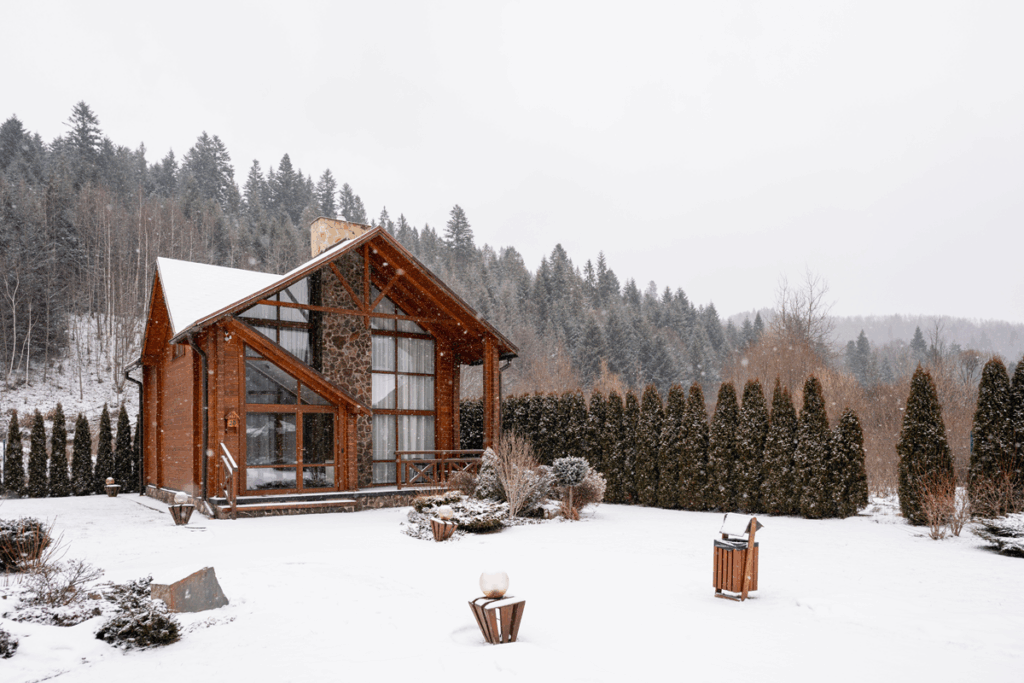
East bench and mountain communities in Utah County can receive substantial snowfall – in some areas exceeding 100 inches annually. Snow load requirements vary significantly by elevation and community, and the structural systems supporting a roof in Summit Creek or the Mapleton foothills need to be engineered accordingly.
Beyond structural adequacy, roof design in high-snowfall environments must address ice dam prevention – a condition where heat escaping through the roof deck melts snow, which then refreezes at the eaves and forces water under shingles. Proper attic insulation, ventilation design, and eave detailing are non-negotiable in quality mountain community builds.
Low Humidity and Dry Air
Utah County’s semi-arid climate creates specific challenges for interior materials. Solid wood cabinetry, hardwood flooring, and large-panel interior doors all respond to humidity changes through expansion and contraction. Homes built without accounting for the significant seasonal humidity swings – from the dry winter heating season to the more humid late-summer monsoon period – often see cracking, gapping, and movement in wood elements that are not properly specified.
High-end custom builds address this through engineered wood products where movement tolerance is important, properly sized whole-home humidification systems, and material selections that are appropriate for the humidity range the home will actually experience.
Seismic Considerations
Utah County sits within a geologically active region. The Wasatch Fault – one of the most significant seismic hazards in the western United States – runs north-south along the base of the Wasatch Mountains. While large earthquakes are infrequent, the geologic reality means that structural systems in quality custom builds should address seismic loading in addition to gravity and lateral wind loads.
This is particularly relevant for hillside homes where foundation design, retaining structures, and soil conditions interact with seismic loading in complex ways.
Design Responses That Elevate Both Performance and Aesthetics
Roof Pitch and Form
Steep roof pitches are not just aesthetic – in high-snowfall environments, they shed snow loads efficiently and reduce ice dam risk. Many luxury mountain homes in communities like Summit Creek and Mapleton incorporate steep-pitched gable or shed roof forms that combine genuine performance advantages with the dramatic architectural character that defines mountain contemporary design.
Exterior Material Selection
The most common exterior material choices on luxury custom homes in Utah County – stone veneer, fiber cement siding, metal panels, and heavy timber accents – are not arbitrary. Each choice reflects a balance of aesthetic intent and climate performance:
- Natural and cultured stone: high durability, UV resistance, minimal maintenance, excellent thermal mass
- Fiber cement siding: resists freeze-thaw cycling better than wood, accepts high-performance coatings
- Standing seam metal roofing: superior snow-shedding, 50+ year lifespan, minimal UV degradation
- Heavy timber structural elements: dimensional stability under temperature extremes when properly specified

Window and Glazing Specification
Windows on luxury homes in Utah County’s climate should achieve several competing objectives simultaneously: admit generous natural light, minimize heat loss in winter, prevent solar heat gain in summer, and maintain structural integrity through significant temperature differentials.
Triple-pane glazing with thermally broken frames, low-e coatings optimized for Utah’s solar angles, and properly engineered installation details are the standard specification in quality builds at this elevation and climate exposure.
Mechanical Systems and HVAC Design
Utah County’s climate makes heating system design particularly consequential. The combination of cold winters – lows regularly below 10 degrees Fahrenheit at elevation – significant altitude, and variable humidity creates conditions where undersized or inefficient mechanical systems produce uncomfortable, expensive homes.
Premium custom builds in the area increasingly incorporate radiant floor heating alongside high-efficiency heat pump systems that provide both heating and cooling with strong seasonal efficiency.
The Difference That Local Experience Makes
Every one of these climate-responsive design decisions requires both knowledge and judgment – the kind that develops over years of building in a specific place and seeing how homes perform over time. A builder who has completed dozens of custom homes in Summit Creek, Alpine, and Mapleton has encountered the freeze-thaw failures, the ice dam callbacks, the wood movement issues, and the seismic detailing questions that a less experienced operator has not faced yet.
That accumulated experience translates directly into a home that looks exceptional on the day you move in and continues to perform well 20 years later.
Summit Construction has been building luxury custom homes in Utah County’s mountain communities since 2011, with hands-on experience navigating the climate, terrain, and material decisions that determine how well a home holds up over time. Visit summitconstructionutah.com to learn more.