You’re driving through Alpine on a Saturday morning, windows down, slowing at every “For Sale” sign posted on an empty parcel. One lot sits flat and clean against the road, utilities stubbed to the property line, mountain views to the east. The next one is steeper, covered in scrub oak, no visible utility markers, but the view is twice as good and the price is $80,000 less.
Which one is the better buy? You genuinely can’t answer that question from the driver’s seat.
The lot is the one decision in a custom home project that can’t be undone. You can change your floor plan. You can swap cabinet selections. You can upgrade your windows mid-build if the budget allows. But you can’t move the land. And the land determines everything that follows: what you can build, what it will cost, how long it will take, and whether the finished home sits right in its setting or fights it.
Utah County has some of the most varied residential terrain in the state, from flat valley-floor parcels in Saratoga Springs and Lehi to steep bench lots in Alpine, Highland, and Springville’s east side. Each type of lot carries its own cost profile, its own construction demands, and its own design possibilities. Choosing well requires knowing what to look for and what to look out for. Schedule a discovery call with Summit Construction to walk through your lot options with a builder who’s worked this terrain since 2011.
Key Takeaways
- The purchase price of a lot is often less than half the story. Site preparation, utility extensions, soil conditions, and slope engineering can add $20,000 to $100,000+ to your actual land cost.
- A geotechnical report before closing is the best money you’ll spend in the entire project. It reveals soil type, bearing capacity, water table depth, and slope stability before they become expensive surprises.
- Solar orientation, prevailing wind patterns, and view corridors should influence your lot selection as much as price and location, because they directly shape your floor plan and your daily experience of the home.
What Makes a Good Custom Home Lot in Utah County
A good building lot and a good-looking lot aren’t always the same thing. The lot that photographs well on the listing might have $60,000 in hidden costs. The one that looks like nothing special might be the cleanest, most buildable parcel on the market.
Here’s what experienced custom home buyers evaluate, in order of importance.
Buildable area and setbacks. Every lot has setback requirements that restrict how close your home can sit to each property line. In most Utah County cities, you’re looking at 20 to 30 feet from the front property line, 15 to 20 feet from the rear, and 8 to 15 feet on the sides. On a generous one-acre lot, setbacks barely matter. On a tight quarter-acre infill lot in Provo’s east bench, they can shrink your buildable footprint to the point where the home you imagined simply doesn’t fit.
Slope and grading. Flat is cheaper to build on. Period. But flat isn’t always available in the neighborhoods where custom home buyers want to live. Bench lots in Alpine, Mapleton, and Springville’s Summit Creek area offer views precisely because they’re sloped. The question isn’t whether slope adds cost. It always does. The question is how much, and whether the view and setting justify the premium.
A general rule: every 5 percent of grade change adds roughly $10,000 to $25,000 in site preparation costs. A lot with a 15-percent slope from front to back could require $40,000 to $80,000 in excavation and engineered retaining walls before foundation work begins. That number isn’t a reason to avoid sloped lots. It’s a reason to know the number before you write the offer.
Soil conditions. Utah County’s geology varies dramatically within short distances. Valley-floor lots near Utah Lake often have clay-heavy soils that expand when wet and shrink when dry. Bench lots closer to the mountains tend toward rocky, well-drained soils that require different foundation approaches. And some areas, particularly in parts of Lehi and Saratoga Springs, have high water tables that affect basement feasibility and foundation design.
A geotechnical report costs $3,000 to $5,000 and tells you exactly what’s under the surface. It’s the single most important pre-purchase investment for any custom home lot in Utah County.
Utilities: The Cost Nobody Talks About at the Open House
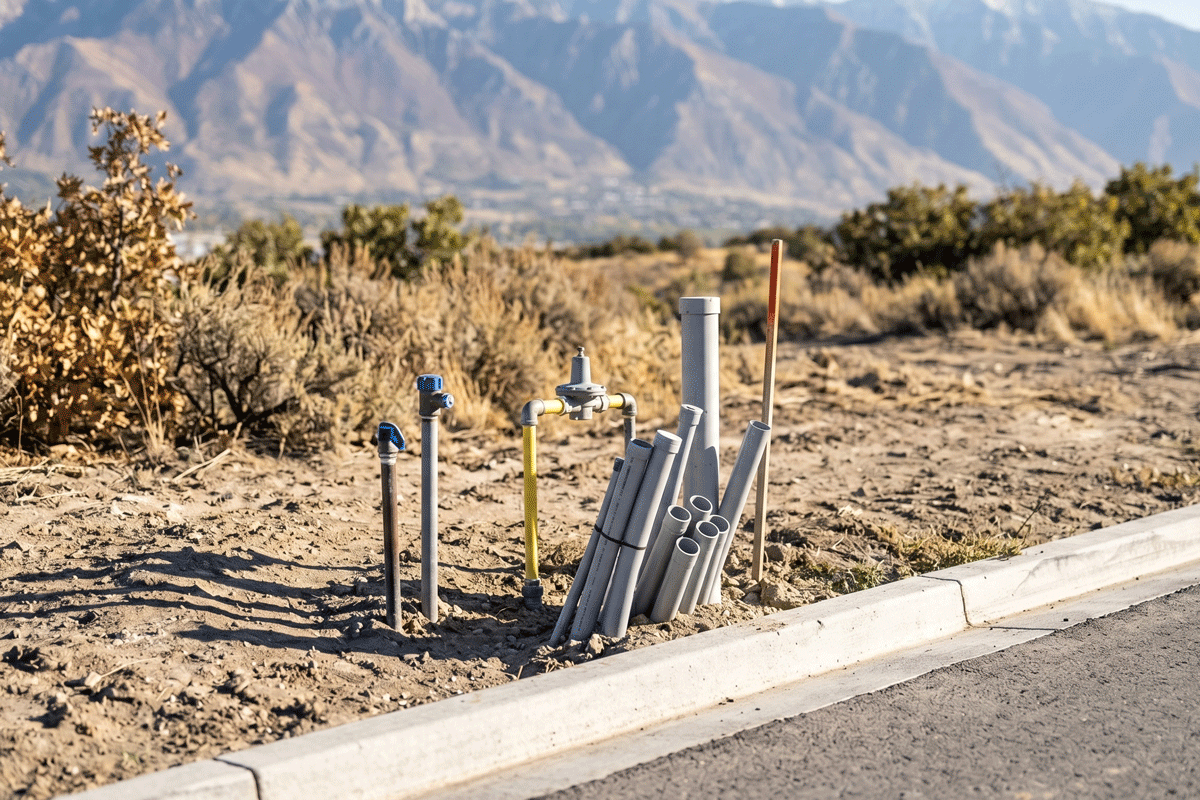
When a lot is listed as “utilities available,” that can mean very different things. It might mean city water, sewer, gas, and power are stubbed to the property line and ready for connection. Or it might mean those services exist somewhere on the street and you’ll need to pay to extend them to your lot.
The difference between those two scenarios can be $5,000 or $50,000.
In established Alpine and Highland subdivisions, utility infrastructure is usually in place. In newer developments on the edges of Lehi, Eagle Mountain, or Santaquin, utility extension costs are sometimes the buyer’s responsibility. Rural parcels in Elk Ridge or the outskirts of Mapleton may require well drilling for water and septic system installation instead of city connections. Well drilling in Utah County runs $15,000 to $30,000 depending on depth. Septic system design and installation adds another $10,000 to $25,000.
Before making an offer on any lot, get written confirmation from the city or county on what utilities are available at the property line, what connection fees apply, and what infrastructure the buyer is responsible for extending. Your builder should help you interpret this information, because the answers directly affect your construction budget.
Solar Orientation and View Corridors
This is where lot selection moves from financial analysis into quality-of-life territory. And it’s the factor most first-time custom home buyers overlook completely.
In Utah County, the sun tracks across the southern sky. A lot with its longest dimension running east-west gives you the best opportunity for passive solar gain in winter, which reduces heating costs and fills your living spaces with natural light during the months when you need it most. A lot oriented north-south works fine but limits where you can place large glass expanses without overheating in summer or losing light in winter.
View corridors matter because they dictate your floor plan before you’ve drawn a single line. If the best view is to the east toward Timpanogos, your great room, primary suite, and outdoor living areas should face that direction. A lot where the view faces the street means your private living spaces look outward while your garage and entry face the view. That’s a design challenge, not a dealbreaker, but it needs to be solved in the floor plan, not discovered after framing.
Prevailing winds in Utah County generally blow from the northwest. A home site exposed to that wind corridor needs a more robust building envelope on the north and west faces, including higher-performance windows and more insulation. A lot sheltered by terrain or mature trees on the north side gives you natural wind protection that translates to both comfort and energy savings over decades.
Walk every lot you’re considering at different times of day. Morning light hits differently than afternoon light. The spot that feels perfect at 10 AM might be in full shadow by 3 PM in January. These details shape how the home feels every single day, and you can only learn them by standing on the ground.
Zoning, HOA, and Entitlement Questions to Ask Before You Buy
Buying a lot without understanding what you’re allowed to build on it is like buying a car without checking if it runs. Here’s the short list of questions to answer before making an offer.
What’s the zoning classification? Residential zones in Utah County cities specify minimum lot sizes, maximum building heights, lot coverage limits, and sometimes architectural standards. Confirm that the home you want to build is permitted under the current zoning.
Is there an HOA with architectural review? Many Alpine, Highland, and Lehi subdivisions have private covenants that go beyond city code. They may restrict exterior materials, roof styles, paint colors, fence heights, and landscaping. Get a copy of the CC&Rs and architectural guidelines before closing.
Are there easements on the lot? Utility easements, drainage easements, and access easements can restrict where you build and how you landscape. These are recorded on the title and should be reviewed by your builder and your attorney before you commit.
Is the lot entitled or raw? An entitled lot has been through the subdivision process, has approved plats, and is ready for building permits. A raw lot may require additional approvals, surveys, or infrastructure improvements before you can build. Raw lots are cheaper for a reason, and that reason is time and money on the back end.
Talk to Your Builder Before You Talk to Your Agent
Here’s the advice that saves the most money and heartache in the entire lot selection process. Bring your builder into the conversation before you make an offer. Not after.
A real estate agent can tell you the lot’s price, its tax history, and the comparable sales nearby. A builder can tell you what it will actually cost to build on that specific piece of ground. They can spot drainage problems the listing photos don’t show. They can estimate site prep costs within a reasonable range before you’ve committed a dollar. They can tell you whether the home you want to build fits the buildable area after setbacks.
Summit Construction has evaluated lots across Utah County for more than a decade, from flat parcels in Salem to steep hillside sites in Alpine. That experience means honest answers about what a lot will cost you beyond the purchase price, and whether the lot supports the home you’re envisioning or works against it. Request a discovery call and bring your lot candidates. We’ll walk the ground with you.
The View From Your Front Door Starts Here
A year from now, you’re going to pull into a driveway that didn’t exist twelve months ago. The lot you chose will be invisible by then, buried under a foundation, wrapped in framing, covered by a roof that belongs against the Wasatch skyline. But every good thing about that home, the light in the morning, the views from the primary suite, the way the wind doesn’t hit the patio because the house sits right on the land, all of it traces back to the lot.
Choose it well and you’ll never think about it again. Choose it poorly and you’ll think about it every day.
Your Next Step
If you’re evaluating lots in Utah County right now, the smartest move is to get a builder’s eyes on them before you’re under contract. Reach out to Summit Construction for a discovery call and bring your top lot options. We’ll give you an honest read on buildability, site costs, and whether the lot supports the home you have in mind. Call (801) 762-7500 or email brady@summitconstructionutah.com. The right lot at the right price is the foundation of everything that follows.
Frequently Asked Questions
How much does a custom home lot cost in Utah County?
Lot prices in Utah County range from under $100,000 in communities like Santaquin and Elk Ridge to $300,000 to $700,000+ in Alpine and Highland. Price depends on acreage, location, slope, view orientation, and utility availability. The purchase price is only part of the total land cost when you factor in site preparation.
Do I need a geotechnical report before buying a lot in Utah County?
Yes, for any lot where you plan to build a custom home. A geotech report costs $3,000 to $5,000 and reveals soil type, bearing capacity, water table depth, and slope stability. It prevents expensive surprises during foundation work and gives your builder the data needed to produce an accurate estimate.
What is the difference between an entitled lot and a raw lot?
An entitled lot has been through the subdivision and approval process, has recorded plats, and is ready for building permit applications. A raw lot has not been formally approved for construction and may require additional surveys, utility infrastructure, and government approvals before you can build. Raw lots cost less upfront but take more time and money to develop.
Should I buy a lot before I hire a builder?
Ideally, no. Bring your builder into the lot evaluation process before you make an offer. A builder can assess site preparation costs, buildable area, utility access, and design feasibility that a real estate listing won’t reveal. This prevents costly surprises after you’ve already committed to the land.
About Summit Construction
Summit Construction builds custom homes across Utah County from its base in Springville, Utah. Since 2011, founder Brady Jensen and his team have completed more than 200 home projects in communities including Alpine, Highland, Mapleton, Lehi, and the Springville east bench. The company’s open-book pricing model and structured 8-step process give clients full visibility into costs and decisions from first conversation through final walkthrough. Summit Construction is a member of NAHB and the Utah Valley Home Builders Association. Call (801) 762-7500, email brady@summitconstructionutah.com, or visit summitconstructionutah.com.