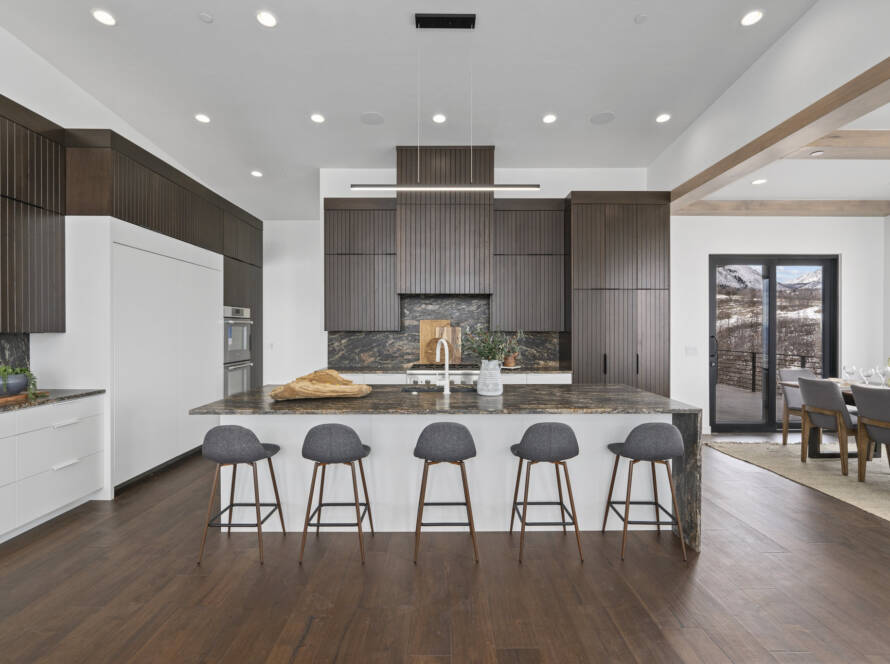
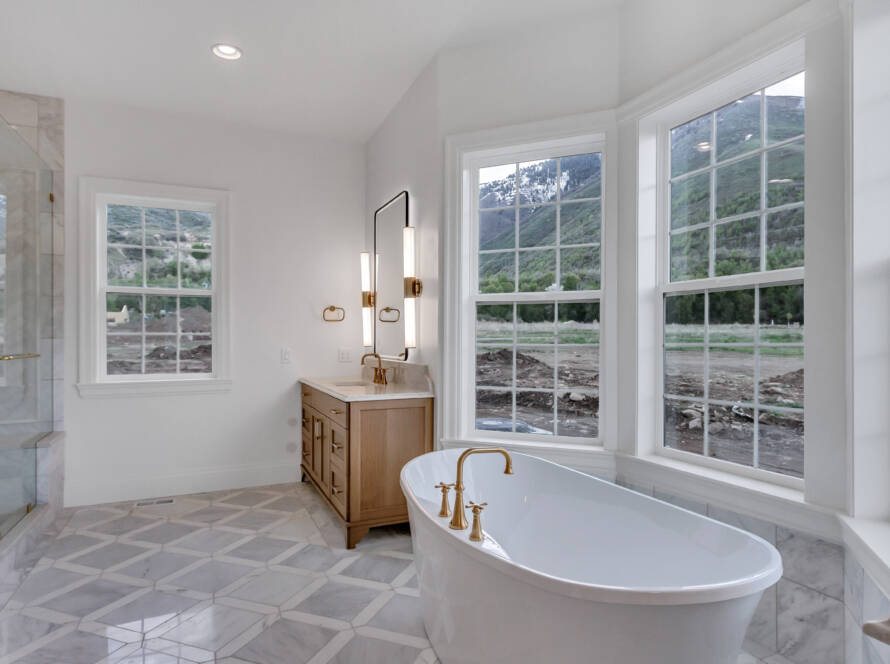
Most homeowners think energy efficiency starts with solar panels. In Utah County, it starts with the walls.
That’s not a knock on solar. Panels make sense here. Utah ranks among the top ten states in the country for solar potential, and net metering programs still offer meaningful return for residential installations. But a solar array bolted onto a poorly insulated, leaky house is like putting a performance engine in a car with bald tires. You’re generating energy just to watch it escape through your building envelope.
The families building custom homes in Alpine, Highland, Springville, and Mapleton right now have a once-in-a-lifetime opportunity that buyers of existing homes don’t. They get to build efficiency into the structure itself, from the foundation up, before the drywall goes on and the choices become permanent. Done right, the energy decisions made during construction pay for themselves every winter for the next thirty years. Done poorly, or not done at all, you’re locked into utility bills that compound and comfort gaps that no thermostat adjustment can fix.
Utah updated its residential building codes in recent years to require better energy performance. That raised the floor. But the floor and the ceiling are very different things, and the distance between code-minimum and genuinely high-performance is where the real value lives. Talk to Summit Construction about what high-performance construction looks like for your specific project and lot.
Key Takeaways
- The building envelope (walls, roof, foundation, windows, and air sealing) determines 70 to 80 percent of a home’s energy performance. Mechanical systems matter, but they can’t compensate for a weak envelope.
- Utah County’s elevation, dry air, and extreme temperature swings between seasons demand a different approach to insulation, moisture management, and HVAC sizing than lower-altitude markets.
- The incremental cost of building a high-performance envelope into a new custom home is a fraction of what it costs to retrofit one later, and the return shows up in both utility bills and resale value.
Why Elevation Changes the Energy Equation
Utah County sits between 4,400 and 5,200 feet above sea level, depending on where you build. Alpine’s upper bench pushes closer to 5,400. That elevation has direct consequences for how a home heats, cools, and breathes.
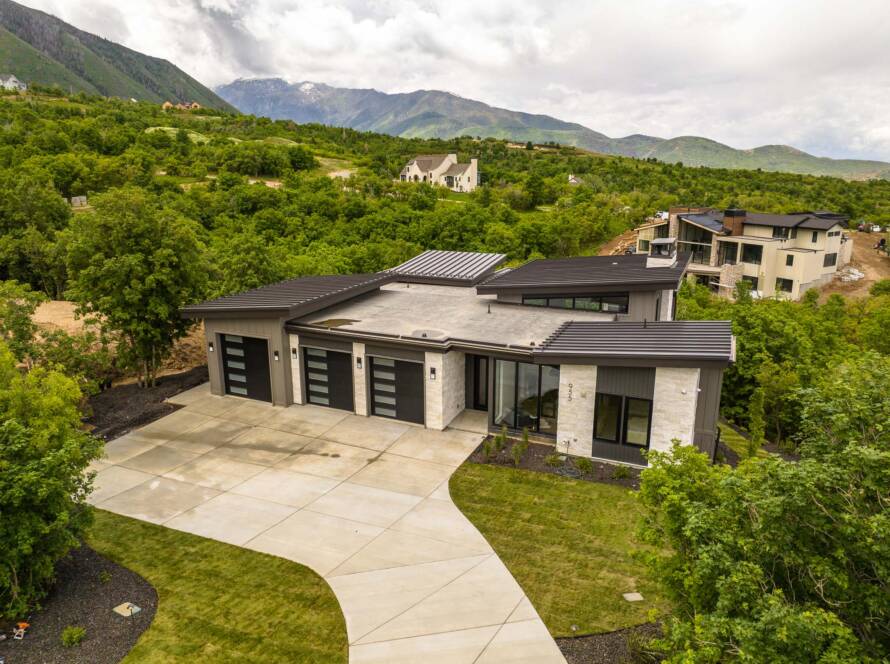
Air is thinner at elevation. Thinner air holds less heat. That means your home loses thermal energy to the outdoor environment faster than an identical home at sea level, particularly on clear winter nights when radiant heat loss to the sky accelerates. The temperature delta between a 68-degree interior and a minus-5-degree January night in Alpine is 73 degrees. Your building envelope is the only thing standing between those two numbers.
UV exposure is also more intense at elevation. According to the EPA, UV radiation increases approximately 6 to 10 percent for every 3,000 feet of elevation gain. That affects exterior materials, roofing longevity, and window performance. Low-E glass coatings that block UV transmission aren’t just protecting your furniture from fading. They’re reducing solar heat gain in summer and slowing radiant heat loss in winter.
Dry air compounds the challenge. Utah County’s winter humidity regularly drops below 20 percent indoors. That dry air escapes through every gap in the building envelope, carrying heated moisture with it and leaving behind a home that feels cold even when the thermostat reads 70. Air sealing isn’t a luxury feature in this climate. It’s the single most cost-effective energy measure you can specify.
The Building Envelope: Where 80 Percent of Performance Lives
If your builder talks about energy efficiency and starts with the furnace, ask more questions. The mechanical system matters. But it’s the building envelope that determines how hard those systems have to work, how evenly the home maintains temperature, and how comfortable you feel in every room.
The envelope has four components, and each one has a job.
Insulation
Utah’s current energy code requires minimum insulation values that have improved over the past decade. But code minimum is designed to be the lowest acceptable standard, not the optimal one. The difference between R-21 wall insulation (code minimum for 2×6 framing) and R-30 with continuous exterior insulation is about $3,000 to $6,000 on a typical custom home. That upgrade reduces heating and cooling loads by 15 to 25 percent for the life of the structure.
For Utah County custom homes, the insulation conversation should include walls, roof or ceiling assembly, foundation or slab edge, and rim joists. Rim joists, where the floor framing meets the exterior wall, are the most commonly under-insulated area in residential construction. They’re also one of the largest sources of air leakage. Spray foam at the rim joist is a small expense with outsized impact.
Attic insulation matters more here than in mild climates because the temperature gradient between a heated living space and an unheated attic is severe for five months of the year. R-49 to R-60 in the attic is a worthwhile investment in Utah County. R-38, the older code minimum, leaves performance on the table.
Air Sealing
A blower door test measures how tightly a home is sealed by pressurizing the interior and measuring air leakage. The result is expressed in air changes per hour at 50 pascals of pressure (ACH50). Code requires 3.0 ACH50 or less. A high-performance custom home should target 1.5 to 2.0 ACH50. Passive House certification requires 0.6 ACH50, which is achievable but adds significant cost.
Where does air leak? Penetrations for plumbing, electrical, and HVAC. Window and door frames. The joint between the foundation and the framing. Recessed light cans. Attic hatches. Every one of these is sealable during construction for minimal cost. After drywall, finding and fixing them costs ten times as much.
The practical impact: a home at 1.5 ACH50 feels noticeably different from one at 3.0. Fewer drafts. More even temperatures room to room. Lower humidity swings. And your HVAC system runs less, lasts longer, and costs less to operate.
Windows
Windows are the weakest thermal link in any wall. A well-insulated wall might achieve R-21 to R-30. A standard double-pane window delivers roughly R-3. Triple-pane windows with low-E coatings and argon or krypton gas fill reach R-5 to R-8, which is still less than the wall but dramatically better than standard glazing.
In Utah County, where winter nights drop well below freezing and summer afternoons push past 95 degrees, the window specification has an outsized impact on comfort and energy bills. Specify low-E coatings tuned for your home’s orientation. South-facing glass should have a higher solar heat gain coefficient to capture free winter heat. West-facing glass should have a lower coefficient to block summer afternoon overheating.
The cost premium for triple-pane over double-pane on a typical custom home runs $8,000 to $15,000. On a $1.5 million build, that’s less than one percent of the budget for a component you’ll interact with visually and thermally every day for decades.
Continuous Insulation
Standard framing creates thermal bridges. Every stud, header, and jack acts as a conductor between the interior and exterior. In a typical 2×6 wall, framing members make up roughly 25 percent of the wall area, and they insulate at about R-6 compared to the R-21 in the cavities between them.
Continuous exterior insulation, a layer of rigid foam or mineral wool applied outside the sheathing and under the cladding, breaks those thermal bridges. Even one inch of continuous insulation (R-5 to R-6) improves the whole-wall thermal performance by 15 to 20 percent. Two inches brings the improvement closer to 30 percent.
This approach is standard in high-performance building. It’s not yet standard in Utah County’s production home market. For a custom home buyer, specifying continuous insulation is one of the highest-value energy upgrades available, because it addresses the physics of the wall assembly, not just the spaces between the studs.
Mechanical Systems: Sized to the Envelope
Once the envelope is optimized, the mechanical systems can be right-sized rather than oversized. This is counterintuitive for most homeowners, but a tighter, better-insulated home needs a smaller furnace, a smaller air conditioner, and simpler ductwork. Smaller equipment costs less to install and less to operate.
In Utah County’s climate, a high-efficiency gas furnace (96 to 98 percent AFUE) paired with a high-SEER air conditioning system is the standard approach. For homes built to higher envelope standards, an air-source heat pump can handle both heating and cooling with a gas furnace backup for the coldest nights. Heat pump technology has improved dramatically in cold-climate performance over the past five years, and current models from major manufacturers operate efficiently down to minus-10 to minus-15 degrees.
The key is matching the system to the envelope. An oversized furnace in a tight home will short-cycle, turning on and off frequently, which reduces efficiency, increases wear, and creates temperature swings. Summit Construction’s build process includes Manual J load calculations that size HVAC equipment to the actual thermal performance of the home, not a rule-of-thumb estimate based on square footage.
What High-Performance Construction Costs in a Custom Home
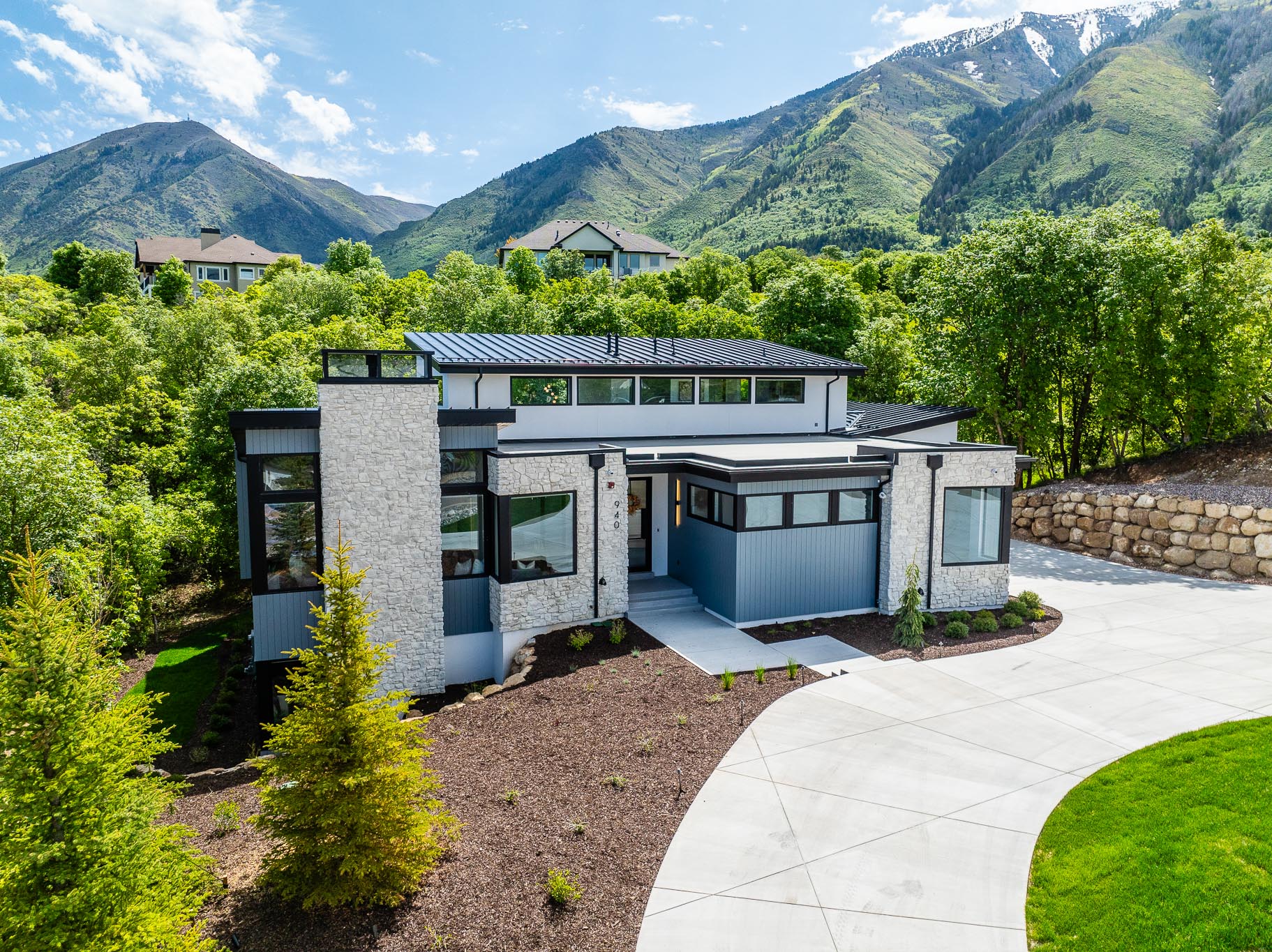
The incremental cost of building a high-performance envelope into a new custom home is far less than most buyers expect.
For a 3,500-square-foot custom home in Utah County, upgrading from code-minimum to high-performance envelope specifications typically adds $25,000 to $50,000 to the construction budget. That covers upgraded insulation, continuous exterior insulation, advanced air sealing, better windows, and properly sized mechanical systems.
According to the U.S. Department of Energy, high-performance homes typically reduce energy costs by 30 to 50 percent compared to code-minimum construction. On a Utah County home with annual energy costs of $3,000 to $4,500, that’s $900 to $2,250 per year in savings. The envelope upgrade pays for itself in 12 to 20 years through energy savings alone, and the comfort difference is immediate from the first winter.
The resale argument is strong too. Energy-efficient homes consistently appraise and sell at premiums in markets where utility costs are visible to buyers. A home with documented energy performance, including a HERS rating or blower door test results, stands out in listings and attracts buyers who understand long-term value.
The Quiet Payoff
January. It’s 6 degrees outside at 6 AM. You walk downstairs in bare feet and the floor isn’t cold. The thermostat reads 69. There’s no sound from the furnace because it cycled off twenty minutes ago and the house is still holding temperature. The windows on the east wall aren’t fogged or frosted. Morning light comes through clean.
You check the utility bill out of curiosity. It’s lower than your old house, which was 800 square feet smaller. The house isn’t just beautiful. It works. Every wall, every window, every sealed joint is doing its job without asking for attention, without making noise, without running up a bill.
That’s what building efficiency into the bones feels like. Not a gadget. Not a label. Just a home that performs the way a home built in 2026 should.
Your Next Step
Energy performance is easiest and cheapest to build in during construction. Once the walls are closed, the opportunity narrows and the cost multiplies. If you’re planning a custom home in Utah County, request a discovery call with Summit Construction to discuss what high-performance construction looks like for your project, your lot, and your budget. We build homes that are comfortable, efficient, and honest about where every dollar goes. Call (801) 762-7500 or email brady@summitconstructionutah.com.
Frequently Asked Questions
How much more does an energy-efficient custom home cost to build?
Upgrading from code-minimum to high-performance envelope specifications typically adds $25,000 to $50,000 to a 3,500-square-foot custom home in Utah County. That covers better insulation, continuous exterior insulation, advanced air sealing, upgraded windows, and right-sized mechanical systems.
What is a blower door test and do I need one?
A blower door test measures how airtight your home is by pressurizing the interior and measuring leakage. Results are expressed in air changes per hour (ACH50). Code requires 3.0 or less. High-performance homes target 1.5 to 2.0. Every new custom home should be tested, and the result should be documented for resale value.
Are triple-pane windows worth the cost in Utah?
Yes, particularly for north and west-facing exposures where heat loss and solar heat gain are most significant. The $8,000 to $15,000 premium on a typical custom home improves comfort, reduces condensation, and lowers energy bills for decades. On south-facing glass, specify a higher solar heat gain coefficient to capture free winter heating.
Do energy-efficient homes have better resale value?
Consistently, yes. Homes with documented energy performance sell at premiums in markets where buyers understand long-term operating costs. A HERS rating or blower door test result included in your listing gives buyers a concrete number to compare against competing homes.
About Summit Construction
Summit Construction builds custom homes in Utah County with a focus on quality, transparency, and construction that performs as well as it looks. Based in Springville and led by Brady Jensen since 2011, the company has completed more than 200 home projects across Alpine, Highland, Mapleton, Lehi, and the Springville east bench. Summit Construction is a member of NAHB and the Utah Valley Home Builders Association. Call (801) 762-7500, email brady@summitconstructionutah.com, or visit summitconstructionutah.com.